Why do weather forecasts go wrong? Chaos and the butterfly effect
Suppose I gave you tickets for a trip to a waterpark in a few months. You would very much like to go, but only on a warm day. Now, despite so many scientists and engineers working on weather prediction, why are you not able to look up what the temperature will be at the waterpark on that day?
In fact, you wouldn’t be able to say with any certainty even two weeks out if it would be a good day for the waterpark. And the reason is surprisingly deep.
It isn’t just that weather prediction is hard, it’s that there is a fundamental barrier preventing us from predicting the weather more than two weeks in advance. By the end of this explainer, you should have an idea of what that is.
“Don’t touch that!” Time travel and the weather
In the late 1960s, a meteorologist (a scientist who studies the weather) discovered the butterfly effect and helped establish the field of chaos theory.
The butterfly effect is a term that has entered the popular consciousness. You may have heard it in conversation or seen it referenced in popular media.
For instance, in Season 6, Episode 6 of The Simpsons, Homer accidentally creates a time machine. Upon arriving in the past, he remembers his father’s warning on his wedding day: “If you ever travel back in time, don’t step on anything, because even the tiniest change can alter the future in ways you can’t imagine.”
In chaos theory, this is known as sensitive dependence on initial conditions. In many systems, a small change to the initial conditions (see the explainer How do we predict the weather) can cause a large difference in the later evolution. This is true in some simple physical systems such as a double pendulum and the much more complex weather.
However, the problem is even worse than that.
Mischievous butterflies and the forecast iron curtain
Sensitive dependence on initial conditions makes precise initial measurements important, but it doesn’t, in principle, limit how far into the future we can forecast.
We could keep measuring the initial positions and velocities of our pendulums with ever-greater accuracy and extend our forecast arbitrarily far into the future.
However, the atmosphere doesn’t behave like this. To see why, let’s imagine the forecast error is like a Russian doll with a match inside.
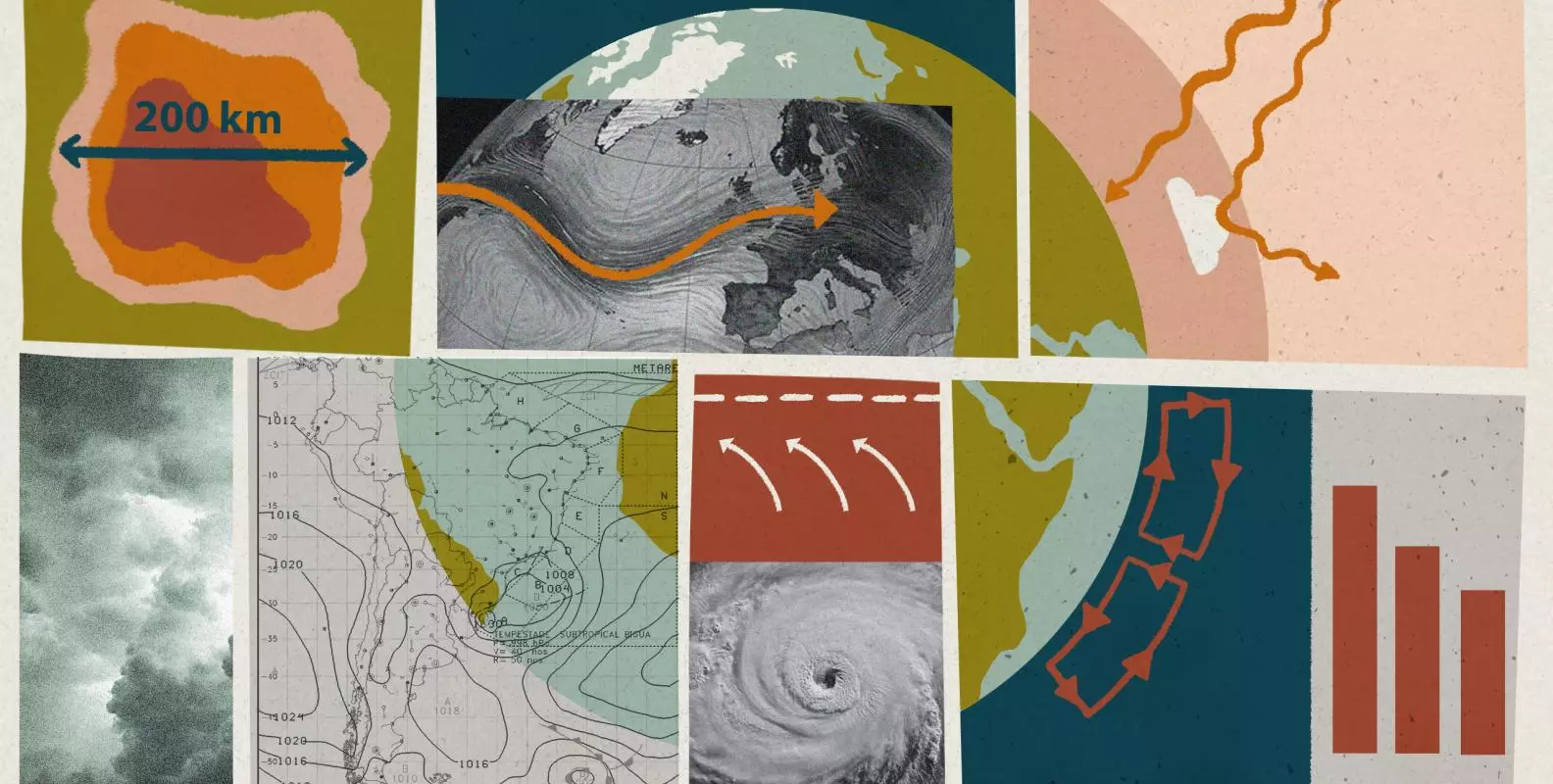
A Russian nesting doll, or Matryoshka doll, is a set of wooden figures of decreasing size, each placed inside the previous one. In our analogy, each doll represents a larger scale of the atmosphere, so the smallest doll could represent the scale of air flowing past the tiny wings of a butterfly, then a few dolls up from this could represent the scale of a single cloud, further still we would find the scale of a large weather system and the largest doll would represent the scale of the whole globe.
The match represents our initial error. Let's assume we have everything larger than the scale of bugs and butterflies completely correct, but we fail to account for the motion of the world's various insects. There would be a complete error, which we will represent as being on fire, in the smallest Matryoshka. The smallest scales are useless to us and burn to cinders.
The key part of this model is that the fire spreads to the next-largest doll and the next, invalidating the forecast at each scale in turn. Why can’t we extend the forecast forever?
The problem is that as the dolls get smaller, there is less wood in them and they burn more quickly. We get diminishing returns as we add more dolls. In the atmosphere, going to the huge expense of upgrading from a resolution of 100 km to 50 km may help you predict a day further into the future, but going to the same expense upgrading 50 km to 25 km only half a day, 25 to 10 only 6 hours, 10 to 5 only 3. In fact, this is a convergent sum. Even if we were to keep doubling our resolution an arbitrary number of times, we would not be able to predict past some finite number. Our estimate for this number is two weeks.
The limits of limits
Of course, you may raise some objections.
As we keep going to smaller scales, won’t we eventually leave the realm of fluid dynamics altogether and face particle physics?
Yes, the model we have described is only valid up to the viscous scale, that is, the scale at which air becomes sticky. Beyond that, the model breaks down, and only in abstract land can we truly keep looking at smaller scales forever. However, this scale is on the order of a millimetre, so it may as well be arbitrarily small, given that our current state-of-the-art global weather simulations run at a kilometre resolution.
Is the flap of a single butterfly's wings really able to change the weather around the world in two weeks?
Maybe, but this is not what our model is about. Our model assumes an error at the smallest scales everywhere in the world. After all, if we are saying the clouds will be wrong in an hour, how could a butterfly in Australia affect the clouds in Manchester when even at the speed of sound, a signal would take over half a day to reach Manchester from Australia? So you should be thinking less about one villainous butterfly causing tornadoes in Texas and more about a global conspiracy of them!
What next?
Despite our inability to predict the weather far into the future, we are much better at predicting the climate. If the weather is the question of whether a particular day is warm or not, the climate is the question of how many warm days we will see in a season. Why do you think climate prediction is still possible years into the future?
There is significant interest in predicting outcomes such as bread prices, crime rates, and the spread of war. Can you think of a reason why these things might be even harder to predict than the weather?
Salah Kouhen
Postdoctoral Researcher
University of Oxford